


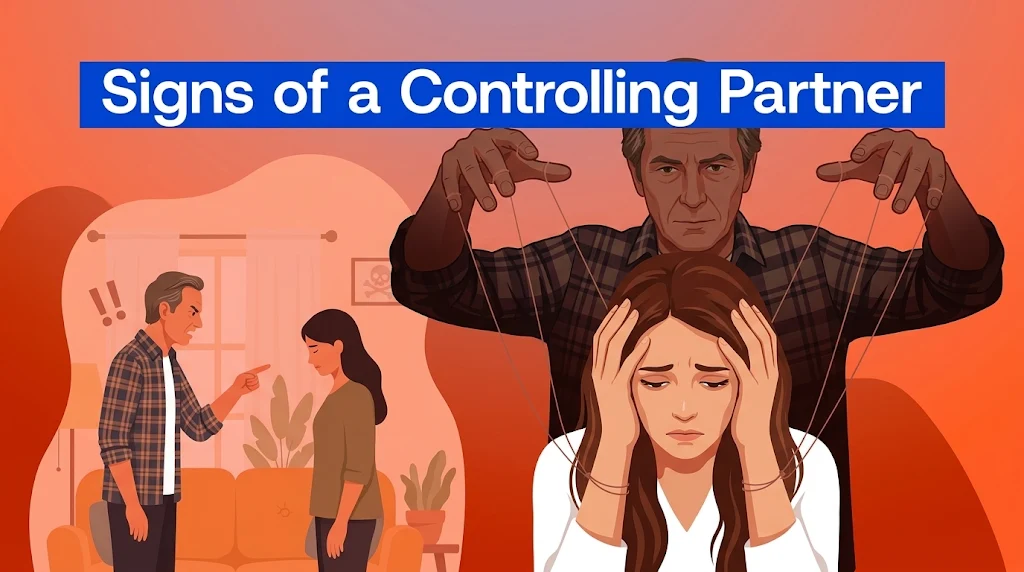
A controlling relationship does not always look controlling at first. Sometimes it begins with frequent questions about where you are, who you are talking to, or why you need time away. It may even be presented as love, concern, jealousy, or a desire to feel close.
Over time, however, those small moments can become rules. You may find yourself explaining ordinary decisions, avoiding certain friends, changing what you wear, checking your phone repeatedly because you are worried about your partner’s reaction, or feeling as though keeping the peace matters more than being yourself.
Knowing how to deal with a controlling partner starts with recognizing that a healthy relationship should have room for two separate people. Love does not require constant permission, surveillance, obedience, or giving up your independence. The National Domestic Violence Hotline describes healthy relationships as ones built around respect, trust, equality, communication, boundaries, and freedom to maintain individual interests and relationships.
The right response depends on what kind of control is happening. A partner who becomes occasionally insecure may respond to honest communication and reassurance. A partner who repeatedly isolates, threatens, monitors, humiliates, or intimidates you is a different situation, and simply communicating better may not make the behavior stop.
What a Controlling Partner May Actually Be Doing

Control can be obvious, but it can also hide inside everyday relationship habits.
A partner may want to know where you are every minute, expect immediate replies to messages, become angry when you spend time with friends, criticize your clothing, demand access to private accounts, question your friendships, or insist that you change plans to accommodate them.
Other forms are less visible. A partner might repeatedly tell you that you are too sensitive, deny things they previously said, make you feel guilty for having your own interests, or suggest that nobody understands you except them.
The important issue is not whether one isolated behavior seems controlling. Look at the pattern and its effect on your freedom.
The NHS identifies behaviors such as controlling what someone wears, who they see, where they go, how they spend money, and whether they can work or study as possible signs of domestic abuse. Monitoring social media and using location technology to track someone can also be warning signs.
Jealousy Is Not the Same as Love
Jealousy is a feeling. Control is a behavior.
Someone can feel jealous without demanding that their partner give up friends, share passwords, stop talking to certain people, or constantly prove their loyalty. Feelings can be discussed; they do not automatically create rules for another person.
This distinction matters because controlling behavior is sometimes disguised as affection.
“Because I love you” can become an excuse for checking a phone.
“I worry about you” can become an excuse for tracking someone’s location.
I just don’t trust other people” can become a reason to isolate a partner.
The explanation does not erase the effect.
A healthy relationship allows both people to have friendships, interests, privacy, and personal decisions while still being committed to each other.
Ask Yourself What Has Changed
One useful way to understand the situation is to compare your current life with your life before the controlling behavior became normal.
Do you feel that you need permission to make ordinary choices? Have you stopped seeing certain people because your partner becomes angry? Do you carefully choose your words to avoid an argument? Are you spending more time proving that you are trustworthy than actually enjoying the relationship?
You might also notice that your world has become smaller.
Perhaps you no longer share things with your friends because you are worried your partner will find out. Maybe you have stopped participating in activities you once enjoyed. You may even have started making decisions based on what will produce the least reaction rather than what you actually want.
That change can be an important signal.
Set Clear Boundaries

If the relationship feels safe enough for an honest conversation, begin by identifying the behavior rather than attacking your partner’s personality.
Instead of saying, “You are a controlling person,” you might say:
“I am not comfortable being expected to respond immediately to every message.”
Or:
“I want to spend time with my friends without being questioned afterward.”
Or:
“I need privacy on my phone, and I am not comfortable sharing my passwords.”
A boundary describes what you are comfortable with and what you will do if that boundary is not respected. It is not a command designed to control another person.
For example, “You are not allowed to talk to your friends” is control.
“I need to be able to maintain my friendships” is a boundary.
The difference is important because healthy boundaries protect individual freedom rather than removing it. The National Domestic Violence Hotline emphasizes that healthy relationships involve respect for boundaries and the ability to spend time apart.
Watch What Happens After You Set a Boundary
Your partner’s response can tell you a great deal.
A healthy response might involve disagreement followed by a conversation. They may need time to understand why something matters to you, but they are ultimately willing to respect your independence.
A concerning response may involve insults, threats, punishment, intimidation, monitoring, guilt, or attempts to make you abandon the boundary.
The question is not whether your partner agrees with every boundary.
The question is whether they believe you have the right to have one.
If your partner repeatedly treats your independence as a personal betrayal, the problem is bigger than a disagreement about one particular rule.
Do Not Give Up Your Support System
Controlling relationships often become more difficult when one person becomes isolated.
Friends, relatives, teachers, counselors, or other trusted adults can provide perspective that is difficult to maintain when you are constantly inside the relationship.
You do not need to tell everyone everything. Start with one person who is trustworthy and likely to listen without judging you.
You can simply say:
I’ve been feeling uncomfortable about some things happening in my relationship, and I need someone to talk to.
That first conversation can make a significant difference.
The National Domestic Violence Hotline recommends maintaining supportive connections because isolation can increase a controlling partner’s power.
If you are a young person and the situation involves threats, intimidation, sexual pressure, or physical harm, speaking with a trusted adult is especially important.
Keep Your Sense of Independence

Losing yourself in a relationship rarely happens all at once.
It can happen through dozens of small compromises.
You stop seeing one friend because your partner dislikes them. Then you stop another activity because it causes arguments. You change your clothes because comments about your appearance become exhausting. Eventually, you may realize that many of your choices are being made around someone else’s reactions.
Try to maintain parts of your life that belong to you.
That could include friendships, hobbies, education, family relationships, personal goals, exercise, creative interests, or simply having time alone.
Being in a relationship should add to your life rather than require you to erase everything outside the relationship.
Be Careful With Digital Control
Modern relationships can create additional opportunities for monitoring.
A controlling partner may demand passwords, repeatedly check online activity, insist on seeing private conversations, monitor location, become angry when messages are not answered immediately, or use social media to keep track of interactions.
These behaviors can seem ordinary because phones are such a central part of relationships. But constant access to someone’s device is not automatically a sign of trust.
Privacy is still possible within a committed relationship.
If digital monitoring becomes part of a broader pattern of control, take it seriously. NHS guidance identifies monitoring social media, using GPS to track someone, reading messages, and controlling communication as potential signs of abuse.
Do Not Confuse Apologies With Lasting Change
A controlling partner may apologize after an argument.
They may promise that they understand now. They may become affectionate and say they will never behave that way again.
An apology can matter, but the more useful question is what happens afterward.
Real change involves taking responsibility, respecting boundaries, and consistently changing behavior over time. It is not simply becoming upset that you considered leaving or promising to do better after every serious argument.
If the same behavior repeatedly returns, pay attention to the pattern rather than judging the relationship by its best days.
The National Domestic Violence Hotline notes that abusive behavior involves power and control and that meaningful change requires the person responsible to recognize and address their behavior rather than placing responsibility on their partner.
Know When Communication Is Not Enough

Communication can help with misunderstandings.
It cannot guarantee that another person will stop choosing controlling behavior.
If your partner listens, accepts responsibility, and works with you to create healthier boundaries, communication may be productive.
But if conversations consistently result in threats, intimidation, humiliation, stalking, physical aggression, sexual pressure, or increased control, the situation should be treated as a safety issue rather than simply a communication problem.
The Hotline specifically warns that confronting an abusive partner can sometimes increase the risk of escalation.
You do not have to prove that your situation is “bad enough” before taking your own discomfort seriously.
When Controlling Behavior Becomes Abuse
Control exists on a spectrum, but certain behaviors are serious warning signs.
These can include restricting contact with family and friends, controlling money, monitoring movements, threatening harm, intimidating you, forcing sexual activity, destroying belongings, preventing you from working or studying, or repeatedly making you feel afraid.
Coercive control can involve a pattern rather than one dramatic incident. NHS guidance describes controlling or coercive behavior as patterns that can include isolation, monitoring, intimidation, humiliation, and restrictions on everyday life.
If you recognize several of these patterns, it may be more accurate to think about the situation in terms of abuse and safety, rather than simply asking how to make the relationship healthier.
What to Do If You Feel Unsafe
If your partner threatens you, physically harms you, forces sexual activity, prevents you from leaving a situation, stalks you, or makes you genuinely afraid of what might happen, prioritize safety over winning an argument.
You do not need to confront the person to prove that you are strong.
Consider reaching out to a trusted person who can support you. If you are under 18, a trusted adult such as a parent, relative, teacher, school counselor, or another responsible adult can be an important source of help.
If you believe you are in immediate danger, contact your local emergency services or move toward a safer place if you can do so safely.
Safety planning should be individualized because leaving or confronting a controlling person can sometimes increase risk. The National Domestic Violence Hotline recommends creating a safety plan that takes the person’s specific circumstances into account.
You Are Not Responsible for Changing Your Partner
One of the hardest things to accept is that you cannot make another person become respectful.
You can communicate clearly. You can explain how their behavior affects you. You can set boundaries. You can encourage healthier behavior.
But you cannot control whether they choose to respect those boundaries.
If your partner repeatedly chooses control, intimidation, or abuse, that choice belongs to them.
This is especially important when someone has spent a long time believing that if they communicate better, love harder, or behave perfectly, their partner will finally stop.
A relationship cannot become healthy through one person’s effort alone.
What a Healthier Relationship Looks Like

It can be difficult to recognize healthy behavior when control has become normal.
A healthier relationship gives both people room to have individual lives. You can disagree without being punished. You can say no without being threatened. You can spend time with other people without being accused of betrayal.
There is also room for privacy.
Healthy relationships involve trust, communication, respect, equality, and boundaries. The National Domestic Violence Hotline describes these qualities as important parts of a healthy partnership.
A healthy partner does not need to control every part of your life to feel secure in the relationship.
How to Start Finding Yourself Again
If controlling behavior has already changed how you live, rebuilding independence can take time.
Start with small decisions that are genuinely yours.
Reconnect with someone you trust. Return to an interest you stopped pursuing. Spend some quiet time thinking about what you want without immediately considering how your partner will react.
It can also help to write down your thoughts. Not because you need to build a case against your partner, but because writing can make patterns easier to see.
Ask yourself:
What do I want?
What am I afraid will happen if I say it?
Which choices am I making because I genuinely want them?
Which choices am I making simply to avoid my partner’s reaction?
Those questions can help separate your own preferences from the expectations that have gradually taken over the relationship.
The Bottom Line
Learning how to deal with a controlling partner is not about becoming better at keeping someone else happy. It is about understanding what healthy partnership requires and recognizing when control has replaced respect.
A healthy relationship leaves room for independence, friendships, privacy, boundaries, and disagreement. You should not have to shrink your personality, abandon important relationships, or constantly prove that you deserve trust.
If the behavior is mild and your partner is genuinely willing to listen, clear boundaries and honest conversations may help. But when control involves intimidation, isolation, threats, monitoring, sexual pressure, financial restrictions, or physical harm, it is important to treat the situation seriously and seek support rather than trying to solve everything alone.
You do not have to make every decision today. You can start by talking to someone you trust, learning more about what is happening, and thinking carefully about what you need to feel safe and respected.
Most importantly, loving someone does not require losing yourself.